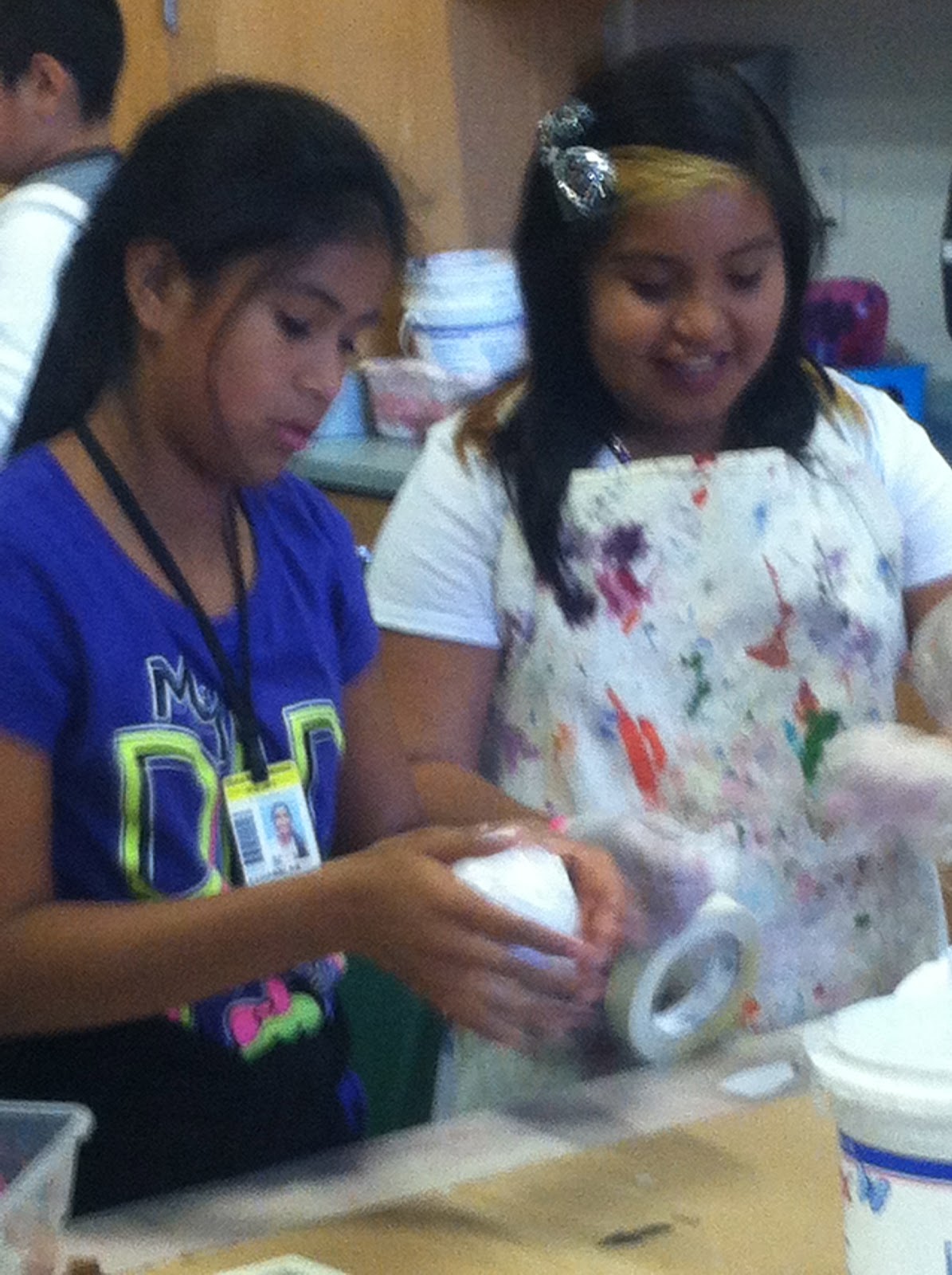
It is my belief that art is a vital component of any functioning and thriving society. It is a necessary method of communication and provides a universal language that can unite us all. A multicultural art education provides children an opportunity to express themselves creatively and develop their own visual literacy by studying art production and art history from around the globe. My role as a teacher is to coach and encourage students to become lifelong learners. I also believe children learn through direct, hands-on experiences and should have some input into their own educational experiences. I am previously trained and have taught within the Reggio Emilia approach to early childhood education which encourages collaboration between students, teachers, and parents in developing a comprehensive and cooperative curriculum (Edwards, Gandini, & Forman, 1993, p. 3-5).
"In Reggio Emilia, education is seen as a communal activity and sharing of culture through joint exploration between children and adults who together open topics to speculation and discussion. The approach provides us with new ways to think about the nature of the child as learner, the role of the teacher, school organization and management, the design and use of physical environments, and curriculum planning which guides the experience of joint, open-ended discovery and problem solving." (Edwards et al, 1993, p 5).
Even though this approach is typically geared towards early childhood education, I believe it to be effective in the K-12 classroom as well. I have a lifelong passion for the creative and performing arts and am eager to share my experience, passion, and enthusiasm with students. My hope is that my dynamism for the arts is contagious. Art is a conduit for assisting students with self discovery, self-discipline, and opens up a unique world of imaginative possibilities.
My purpose as a teacher is for students to be able to see and apply art to everyday life and gain appreciation for different cultures around the world. Along the lines of the theories of John Dewey, in my classroom children will be encouraged to explore the search for meaning through their own creativity and become able to apply different perspectives to other academic subject matters and life (Hurwitz & Day, 2001, p. 8). Critical and analytical thinking are integral to a successful classroom. Prompting students to ask questions help them feel more directly involved in the classroom, provides a check for understanding, and reasserts that each child’s concerns are valid. Essential components to a successful art classroom are interactive, hands-on experiences and art projects.
As a teacher I will provide guidelines, demonstrations, and assistance but allow children the freedom to explore and discover new ways of learning and art production on their own. I was exposed to the theories of Betty Edwards at a young age and my own work and teaching experience has taught me that we can become better artists by changing the way we see, not the way we draw, because our drawings will reflect that newfound awareness when we are able to look at things differently (Edwards, 1979, p. 4).
An effective teacher will be able to balance and juggle many responsibilities at once in a professional manner. The ability to have a keen observational eye to monitor and each student can help cut back in the need for disciplinary actions. If children are kept busy and not idle, they will also be more likely to succeed in the classroom. Positive reinforcement and redirecting children’s behavior are effective methods for managing a classroom. A sense of humor is also a must when working with children as it allows everyone to enjoy their experience, remind them that it is all right to make mistakes, and that effective learning is possible when having fun.
Developing a respectful and orderly classroom where children feel safe and free to express themselves will strengthen their learning capabilities. General rules of mutual respect and conduct will be made clear from the beginning and students will understand the meaning and consequences of disrespectful behavior. Consequences will be fair, firm, and also apparent from the beginning of instruction. Students will not have to guess at what behavior will not be tolerated thus creating a safe environment.
Children will be given clear objectives, outlines, and instructions for projects and performance in order to improve their assessment. Grades will still be issued, but critiques, effort, skill, innovation, and class participation will play a larger role in their success in the classroom. I intend to create strong lesson plans and effective implementation of Discipline Based Art Education (DBAE) which is a wide-ranging approach to art education that draws upon four art disciplines: art production, art history, art criticism, and aesthetics (Dobbs, 1992, p. 3). I believe DBAE helps students put their own art-making within a historical context where they are able to academically address materials and techniques of art-making, assess art critically, and explore the boundaries of the definitions of art. Children will understand what is expected of them for any given assignment and how they will be graded and assessed. Questions will of course be encouraged as well as opportunities to improve or finish work if it does not fit the rubric.
Students’ grades will reflect positively on those who participate in class and work hard on projects regardless if they show a particular affinity for the medium. Texas Standards will be implemented according to the Texas Essential Knowledge and Skills (TEKS) format. The classroom will incorporate the four basic strands of Art instruction: perception, creative expression/performance, historical and cultural heritage, and critical evaluation. Students will be challenged to increase and use their visual awareness, memory, and imagination and life experiences as fuel for creating works of art.
The classroom will create an experience in which every student feels welcome and comfortable including any students with special needs. An Individualized Education Program (IEP) will be suited to fit each child’s needs if necessary. I feel that my enthusiasm for learning and sharing will inspire and stimulate my students to learn and find their own passions in arts education. I thoroughly enjoy all the core subjects of academia and connecting them to the arts and want my future students to understand the beauty and power of knowledge in one’s capacity to learn and create. I hope my own excitement and dedication to the arts will inspire and expand the minds and creativity of all students.
References
Dobbs, M.D. (1992). The DBAE handbook: an overview of discipline- based art education. Retrieved from http://www.eric.ed.gov/PDFS/ED349253.pdf
Edwards, B. (1979). Drawing on the right side of the brain: a course in enhancing creativity and artistic confidence. Los Angeles, CA: J.P. Tarcher, Inc.
Edwards, C., Gandini, L., & Forman, G. (Ed.). (1993). The hundred languages of children: the reggio emilia approach to early childhood education. Norwood, NJ, Ablex Publishing Corporation.
Hurwitz, A., & Day, M. (2001). Children and their art: methods for the elementary school, 7th edition. New York, NY, Harcourt College Publishers.